Critical thinking
While I'm hard at work in archives with pencils...

…The world seems to be in total self-destruct mode. Not just in terms of wars and invasions, or the neglected jungle that is our climate crisis, but in the broader sense of our ability to see the woods from the trees, the real from the frankly absurd. The positive from the destructively negative.
I don’t know about you but I’ve listened to a lot of nonsense recently, from the usual suspects and also from people who should know a lot better. I think half the problem is all the bad actors out there; the other that we’ve lost the ability to reason beyond our need. We’re all Lear now, howling in the storm of 24/7 baloney. And often believing it without even trying.
So a good time I thought - because I am knee deep in dusty research on something far too wonderful to talk about here yet - to use AI to do what it does best: make a bunch of stuff up that’s quite a helpful starting off point for some old fashioned thinking. Here we go. Actually, now I’ve laid it out below, maybe the age-range best suited to the lessons is not 7 - 11 but 5 - 95… I know I need to keep reminding myself.

Hard Books hard at work
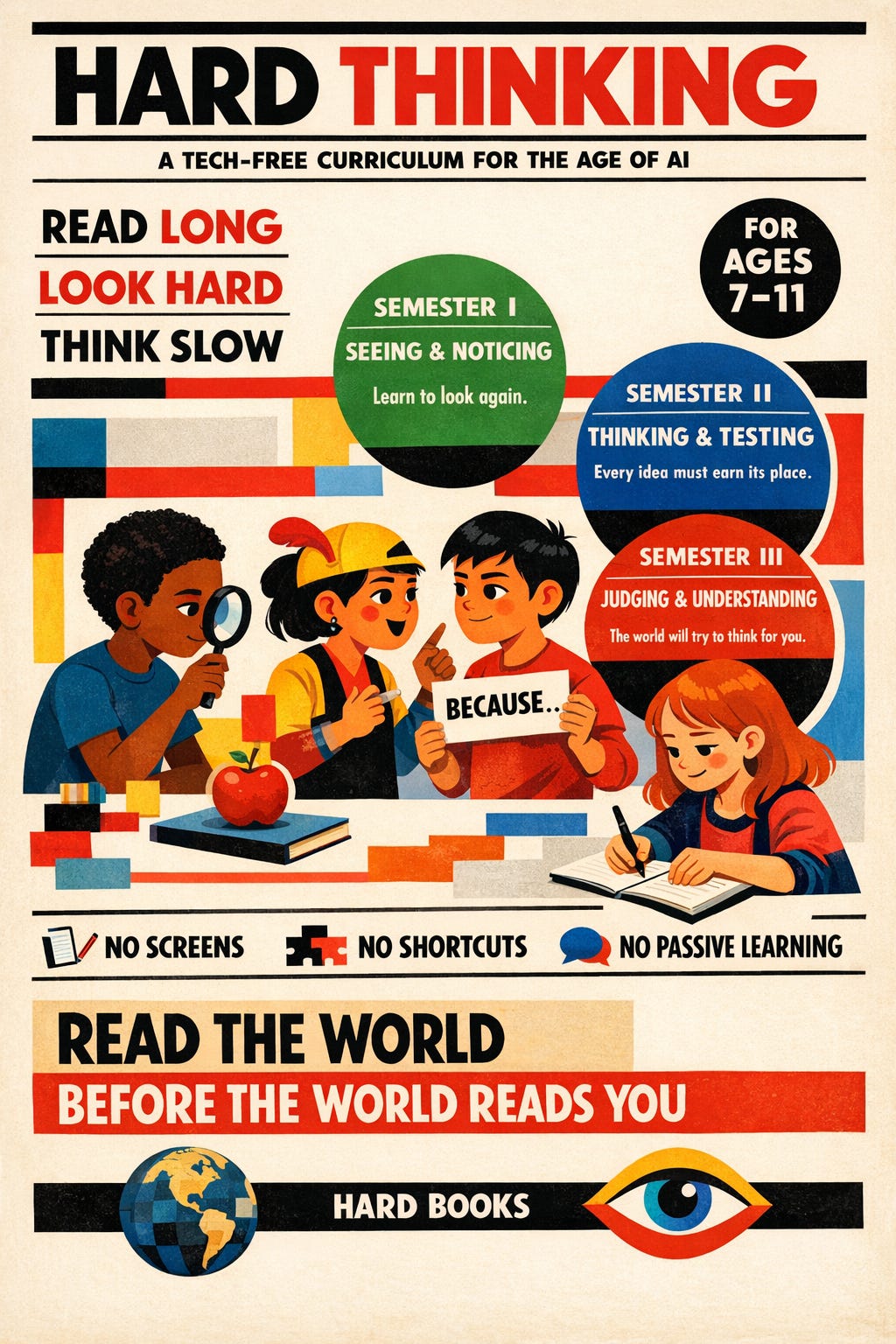
THE HARD THINKING PROGRAM (Ages 7–11)
Subtitle: Read the world before the world reads you
SEMESTER 1: SEEING & NOTICING
Foundation: attention, description, difference
Core idea: Most children don’t struggle with thinking - they struggle with seeing clearly. We begin by slowing perception down.
Week 1: What is noticing?
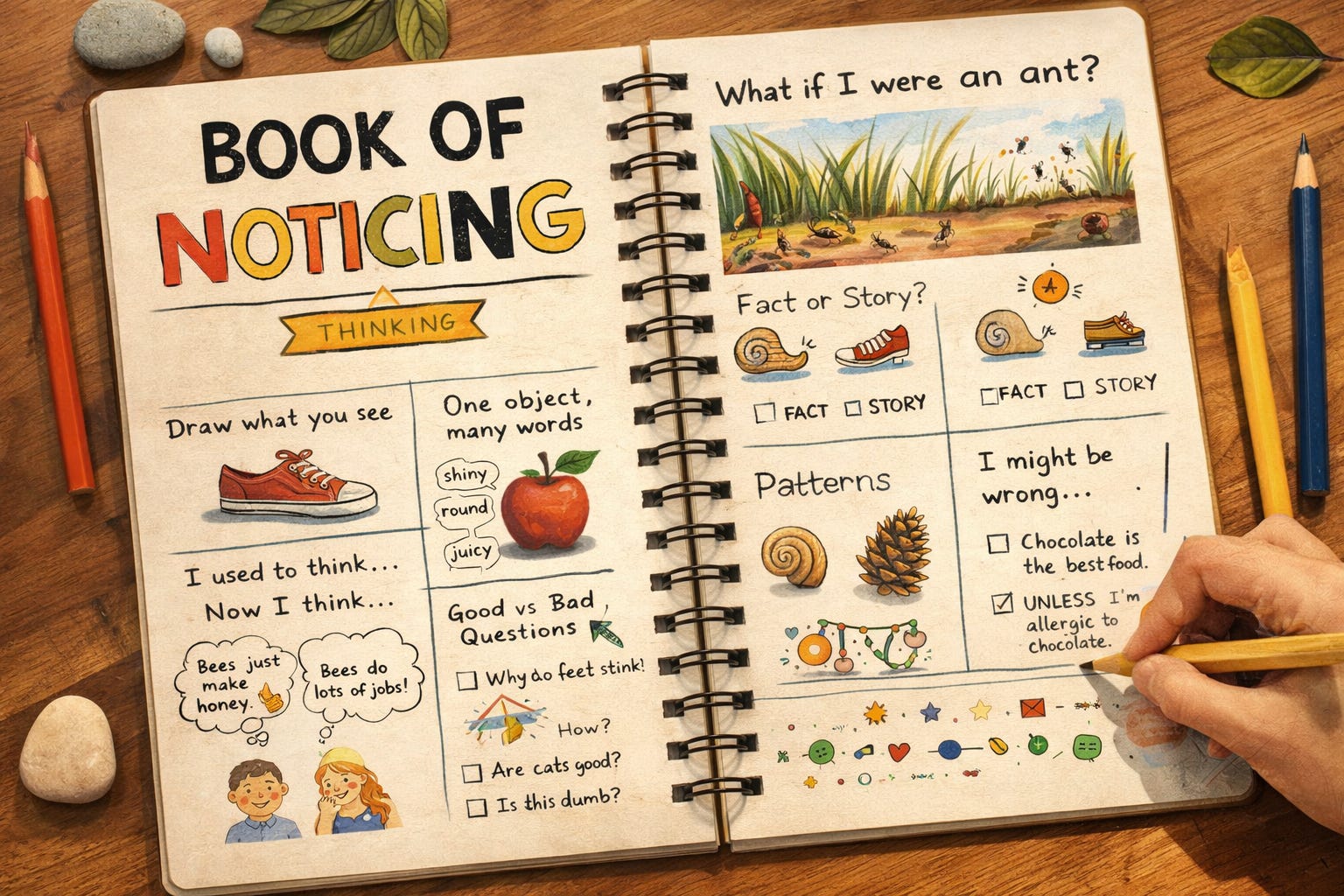
Class 1: “Look Again” - observe a simple object (apple, shoe). Describe it 3 times.
Class 2: Draw vs describe - what words miss, what drawing misses.
Week 2: The difference between seeing and assuming
Class 1: Show ambiguous images → “What do you know vs guess?”
Class 2: Game: “I might be wrong” - children revise statements.
Week 3: Details matter
Class 1: Memory challenge - describe a room after leaving it. [RH, sounds familiar, memory palace or what?]
Class 2: “Spot the change” physical game.
Week 4: Language shapes reality
Class 1: One object, many descriptions (rich vs poor language)
Class 2: Rewrite boring sentences into vivid ones
Week 5: Perspective
Class 1: Tell the same story from 3 viewpoints
Class 2: Role-play disagreements
Week 6: Patterns
Class 1: Find patterns in nature (leaves, shells, numbers)
Class 2: Break patterns intentionally
Week 7: Questions
Class 1: Turn statements into questions
Class 2: “Good vs bad questions” sorting game
Week 8: Truth vs story
Class 1: Fact vs interpretation exercises
Class 2: Rewrite a “fact” as a story and vice versa
Week 9: Listening
Class 1: “Listening at the next table” (your phrase made literal)
Class 2: Repeat someone’s idea before adding your own
Week 10: Synthesis
Build a “Book of Noticing” (drawings, notes, reflections)
SEMESTER 2: THINKING & TESTING
Foundation: logic, reasoning, contradiction
Core idea: Thinking is not having opinions - it’s testing them.
Week 1: What is a reason?
Class 1: “Because…” - children justify simple claims
Class 2: Strong vs weak reasons
Week 2: Cause and effect
Class 1: Domino experiments
Class 2: False causes (“I wore lucky socks, so we won”)
Week 3: Evidence
Class 1: What counts as proof?
Class 2: Bring an object and defend what it is
Week 4: Mistakes in thinking (gentle fallacies)
Class 1: “Everyone says it” (bandwagon)
Class 2: “He’s bad so he’s wrong” (ad hominem simplified)
Week 5: Comparing ideas
Class 1: Which is better and why?
Class 2: Ranking tasks (with justification)
Week 6: Changing your mind
Class 1: Debate → forced reversal
Class 2: “I used to think… now I think…”
Week 7: Imagination as thinking
Class 1: What if gravity stopped?
Class 2: Build impossible worlds logically
Week 8: Rules and fairness
Class 1: Invent a game → test fairness
Class 2: Modify rules to improve it
Week 9: Argument building
Class 1: Build a 3-step argument (claim–reason–example)
Class 2: Present to group
Week 10: Synthesis
Create a “Thinking Toolkit” booklet
🌍 SEMESTER 3: JUDGING & UNDERSTANDING THE WORLD
Foundation: ethics, media awareness, independent thought
Core idea: In the AI era, the child must learn not just to think - but to resist being thought for.
Week 1: What is truth?
Class 1: Simple philosophical discussion
Class 2: Can two people both be right?
Week 2: Trust and sources
Class 1: Who do you trust and why?
Class 2: “Reliable vs unreliable narrator” storytelling
Week 3: Persuasion
Class 1: Analyse adverts (drawn/described, not shown digitally)
Class 2: Create your own persuasive poster
Week 4: Bias
Class 1: “My team vs your team” thinking
Class 2: See both sides exercise
Week 5: Emotions and thinking
Class 1: When feelings help thinking
Class 2: When they confuse it
Week 6: Group thinking
Class 1: Conformity experiments (gentle, playful)
Class 2: Standing alone exercise
Week 7: Stories shape belief
Class 1: How stories influence what we think is true
Class 2: Rewrite a story to change its message
Week 8: AI without using AI
Class 1: “What would a robot say?” vs human answer
Class 2: Identify pattern vs original thought
Week 9: Responsibility
Class 1: If you are wrong, what do you do?
Class 2: Owning mistakes
Week 10: Final synthesis
Build a “Manual for Thinking Clearly”
Present to parents or another class
🧠 Core Teaching Methods (the hidden spine)
1. Dialogue over instruction
Socratic but gentle—children discover, not receive.
2. Embodied learning
Move, act, role-play. Thinking is physical.
3. Repetition with variation
Return to the same ideas (truth, evidence, bias) in new forms.
4. Slow attention
Deliberately resist speed. Silence is allowed.
📦 Materials (deliberately minimal)
Paper notebooks (their “thinking books”)
Pencils, coloured pencils
Physical objects (stones, fruit, toys)
Printed cards (questions, scenarios)
No screens
🧭 The deeper aim (your language, distilled)
This is not a curriculum.
It is a counter-environment.
Where:
speed is replaced with duration
answers are replaced with questions
performance is replaced with attention
In the Hard Books idiom:
Teach them to read before they are read.
Teach them to think before they are prompted.
Not a bad start I’d say. I guess next time we might have a think about STEM, MAGA, borders, wars vs invasions, truth and nations, religions and myths. Thinking for yourself versus asking the right questions. The real value (or not) of reading E.M Forster.
Anyway, hard books. I’m working on one, I absolutely promise.
Robin, April 12